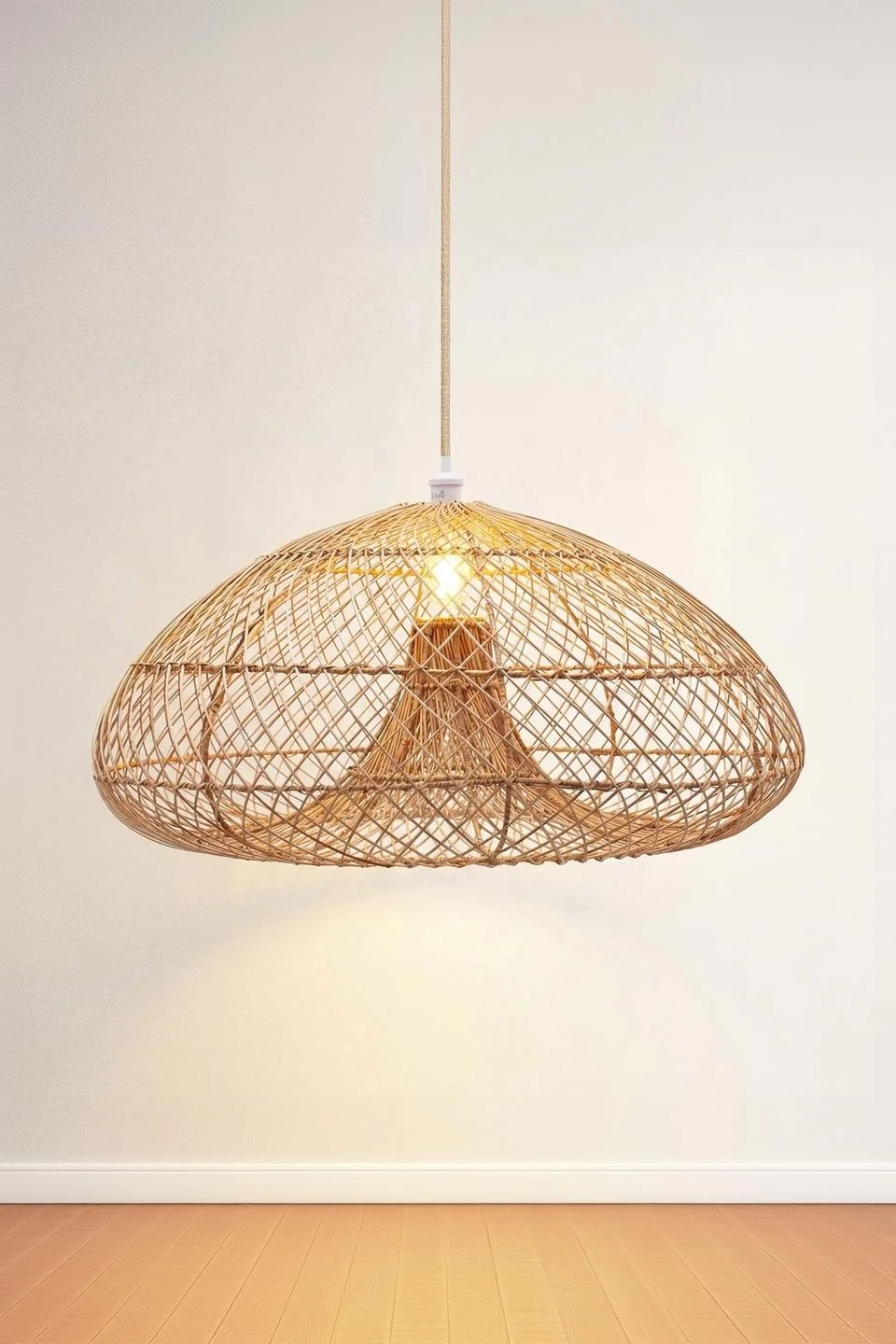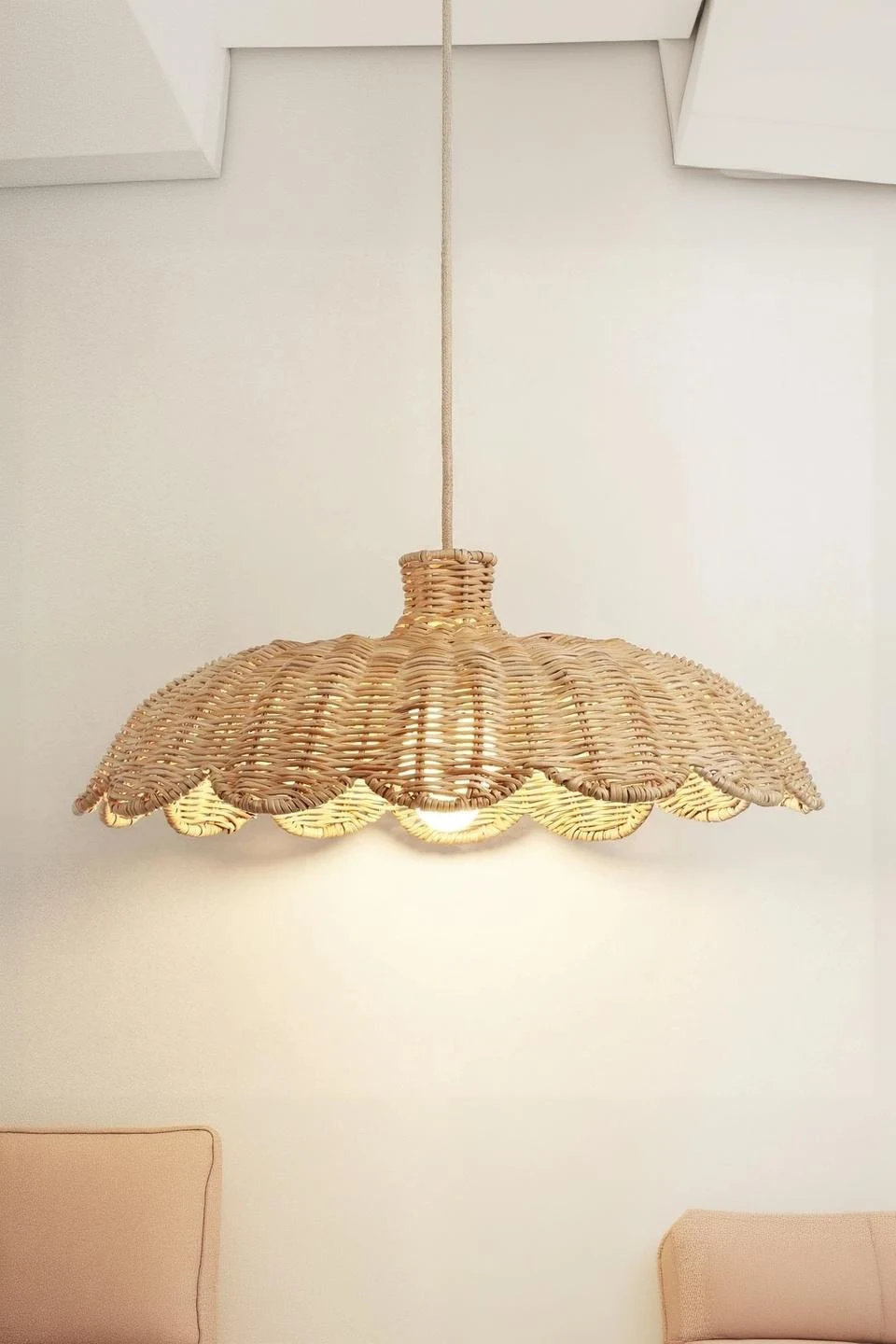
There are exactly three numbers that decide whether a pendant lights your dining room well or quietly bothers you for a decade: diameter, drop height, and the relationship between the two. Get them right and the room reads as deliberate. Get any of them wrong and you'll always feel something is off — even if you can't name what.
This is the practical sizing guide we wrote for ourselves and now hand to anyone who's about to commit. Five minutes here saves you a re-installation later.
The diameter rule (and the one exception)
Standard rule: pendant diameter equals half the table width.
- 48-inch table → 24-inch pendant
- 60-inch table → 30-inch pendant
- 72-inch table → 36-inch pendant
- 84-inch table → 42-inch pendant (or two 24-inch pendants spaced 18 inches apart)
For round tables, use the table diameter directly with the same rule.
The math behind the rule: a pendant at half the table width creates light that falls roughly within the table's outer edge — meaning the table is the brightest surface in the room when the pendant is on. That's what makes the dining experience feel intentional. Light that spreads beyond the table makes the table itself feel less like a destination.
The exception: if your ceiling is over 10 feet or your room is bigger than 200 sq ft, upsize the pendant by 4-6 inches over the standard rule. A 30-inch pendant that's perfect in an 8-foot-ceiling room will look undersized in a 12-foot-ceiling room. Scale matters more than ratio at the extreme.
Drop height (height from table to bottom of pendant)
Standard: 30-36 inches.
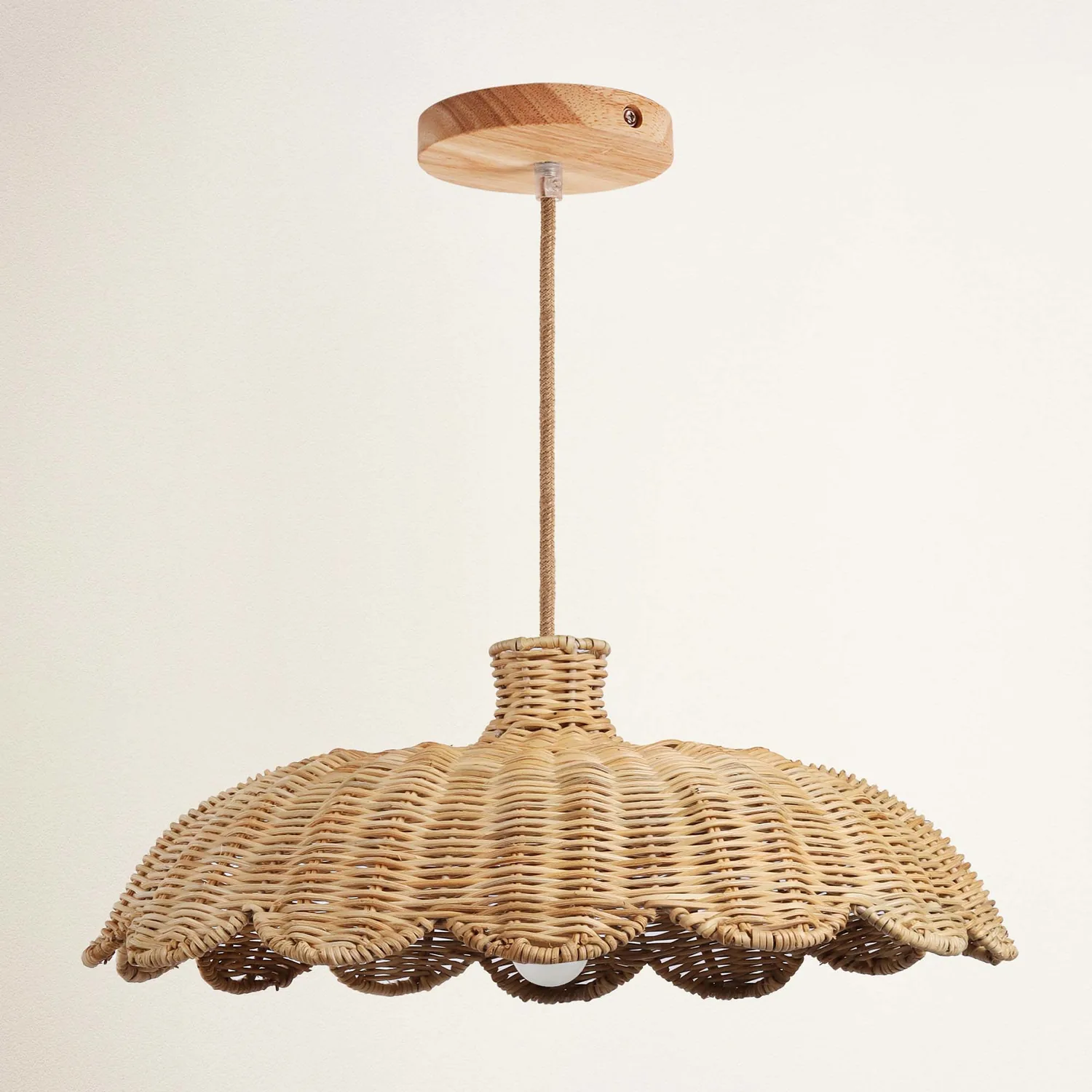
This range exists because tables are not all the same height (29-30 inches standard, 31 inches for some farmhouse tables, 28 inches for vintage), and ceilings vary too. The right number for your specific room:
- Under 8-foot ceiling: 28-30 inches drop
- 8-9 foot ceiling: 30-32 inches drop
- 9-10 foot ceiling: 32-34 inches drop
- Over 10 feet: 34-38 inches drop
The visual logic: from a seated person's eye level (roughly 44-48 inches from the floor), the pendant should hang in the upper third of their visual field but not so high it disappears into the ceiling.
Sanity check: measure from the floor to the bottom of where the pendant will hang. The number should be between 60 and 72 inches. Outside that range, something's off.
Cluster sizing (multiple pendants over one table)
Two pendants over an 84-inch table. Three pendants over a 96-inch (8-foot) table. The cluster gives you a more architectural look than a single statement pendant, and it scales better for very long tables where a single proportional pendant would be impossibly large.
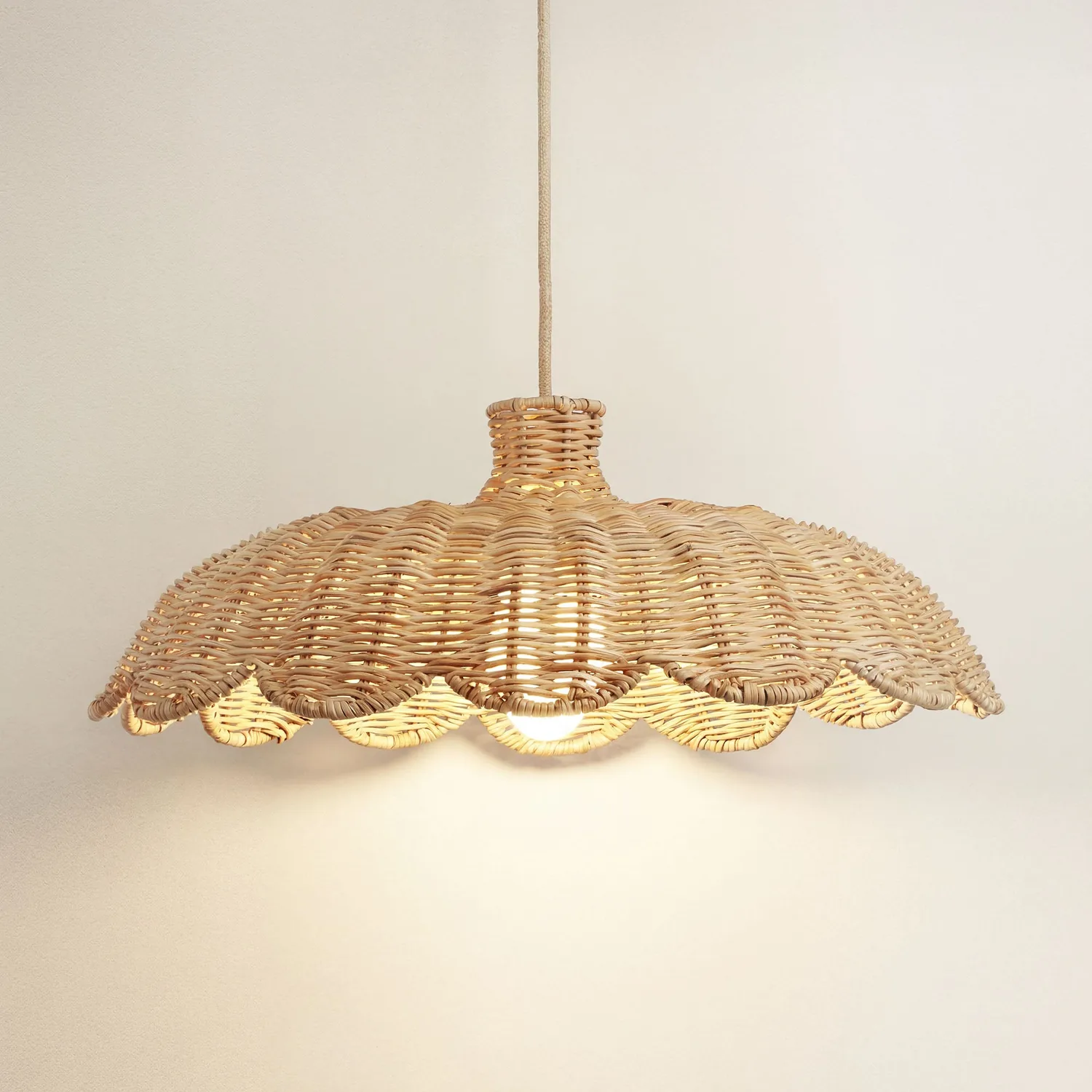
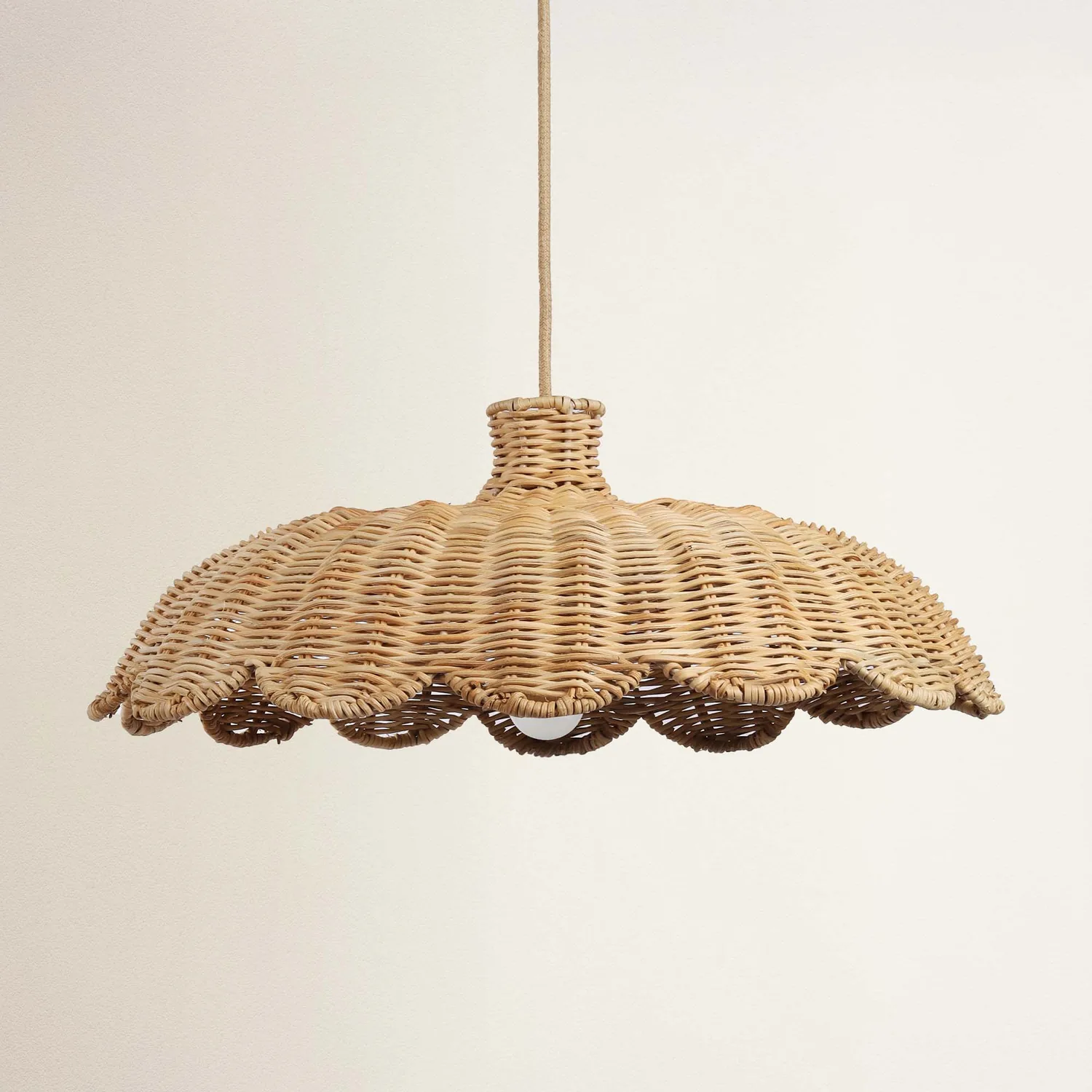
Aurelia Rattan Pendant Light | Handwoven Boho Ceiling Fixture for Dining & Living Spaces
Rowabi · Featured in this article
Spacing between pendants: 24-30 inches center-to-center. Closer feels cramped; further apart starts looking unplanned.
Total cluster visual width: roughly 60% of the table width. So three 14-inch pendants spaced 28 inches apart = a cluster spanning 70 inches, perfect over a 108-inch farmhouse table.
Drop variation: clusters usually look better with all pendants at the same drop height. Staggered drops are an advanced move that works in some contemporary spaces but fails more often than it succeeds.
Where to center it
Center the pendant over the table center, not the room center.
This sounds obvious until you realize most people in older homes have a junction box centered to the room, not the table — and nobody warns you that the table you'll buy will be 6 inches off-center from the junction box. Result: a pendant that hangs visually wrong forever.
If your junction box isn't aligned with where the table will be, the fix is one of three options:
- Move the junction box. Best result, requires an electrician, ~$200-400.
- Use a swag chain to offset the pendant. Wire goes from the existing junction box to a ceiling hook, then over to the pendant. Looks fine in casual rooms; looks improvised in formal ones.
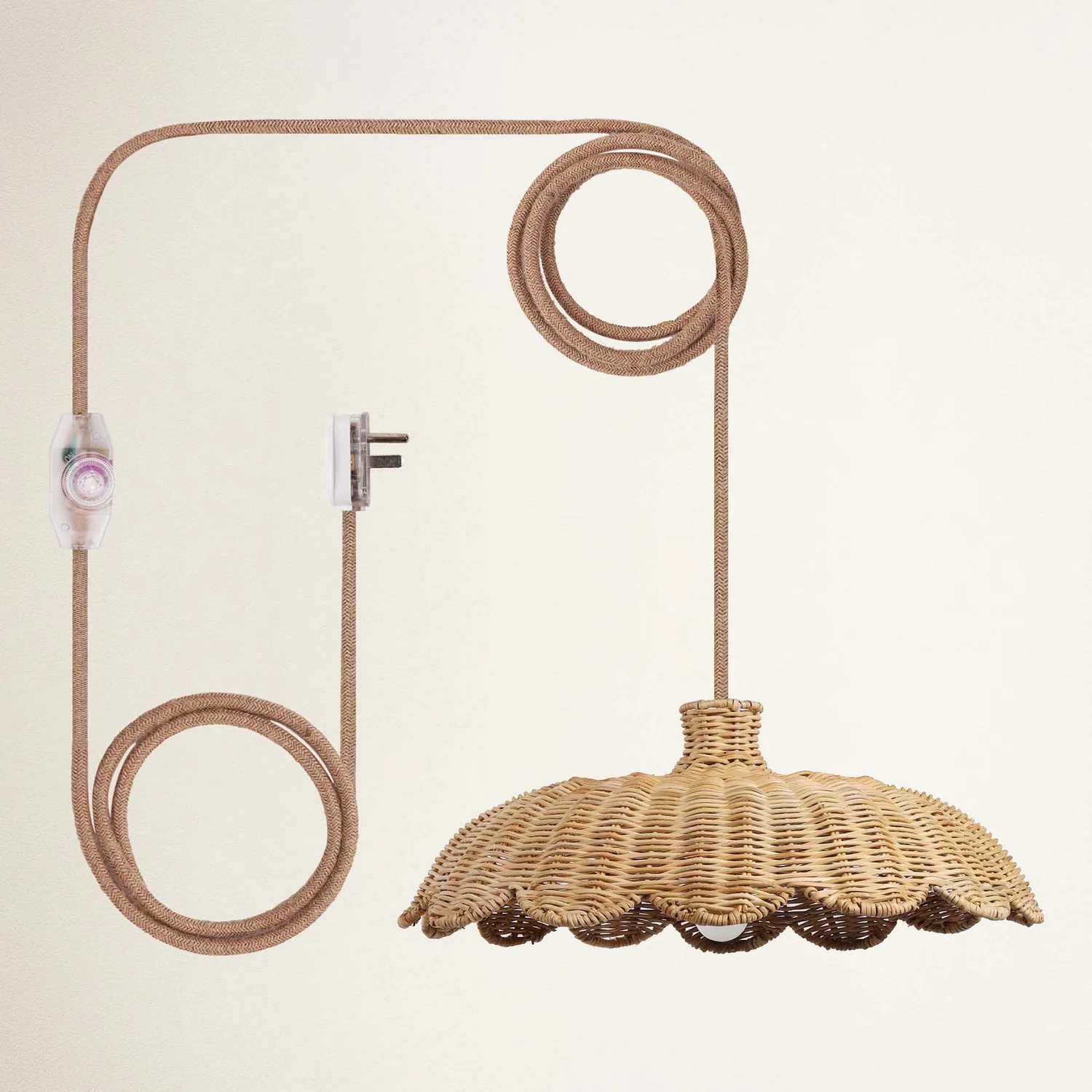
- Plug-in pendant with a cord cover. Solves the problem at zero structural cost. The cord runs along the ceiling line in a discrete white channel.
- Color temperature: 2700K (warm white). Period. Dining is a warm-light context. 3000K reads slightly cooler and works for kitchen islands; nothing above 3000K belongs over a dining table.
- Lumens: 800-1100 per pendant. This is roughly equivalent to a traditional 60-watt incandescent. For a single statement pendant over a six-person table, you might want 1100-1400 lumens.
- CRI (Color Rendering Index): 90+. This is the spec that determines whether food looks appetizing or grey. Cheap bulbs have CRI 70-80; quality bulbs 90+.
- Dimmable. Always. A dining room without a dimmer is missing the entire point of dining-room lighting.
Bulb choice (the part everyone gets wrong)
This is where good lighting gets ruined. The pendant is correct, the size is correct, the drop is correct — and then the bulb is 5000K daylight LED and the whole room reads like a hospital cafeteria.
For dining rooms, we recommend:
If your pendant takes multiple bulbs (cluster pendants often have 3-5 sockets), divide the lumen target by the number of bulbs: 5 sockets x 200 lumens = 1000 lumens total = correct.
Common mistakes (and how to fix them)
"My pendant feels too small for my table."
Diagnosis: 90% of the time, the pendant is too high. Drop it 4-6 inches and re-evaluate before assuming you need a bigger pendant.
"My pendant feels too big."
Almost never the actual issue — usually means the pendant style is too visually heavy (chunky frame, dense weave) for the rest of the room. A 30-inch lacy seagrass globe over a 60-inch table looks fine; a 30-inch chunky industrial drum over the same table looks oversized. Fix is style change, not size.
"My pendant glares at people across the table."
Diagnosis: the bulb is visible from the line of sight at standard sitting height. Fix is either a frosted bulb (lower glare, slightly less light) or a deeper shade that hides the bulb at sitting eye level.
"The light doesn't reach the corners of the table."
Two possibilities: bulb is too low-lumen, or pendant is too narrow for the table. Try a higher-lumen bulb first (cheap fix). If that doesn't work, the pendant is undersized.
"Pendant is centered over the table but the room feels off."
The pendant might be fine but the table itself is off-center in the room. This is a table position problem, not a pendant position problem.
Quick decision matrix
| You have... | We recommend... | |---|---| | Round 48" dining table, 8' ceiling | 24" pendant, 30" drop, 2700K 900-lumen bulb | | Rectangular 72" x 36" table, 9' ceiling | 36" pendant or 3 x 14" cluster, 32" drop | | Long farmhouse 96" x 40" table, 10' ceiling | 3 x 18" cluster spaced 28" apart, 32-34" drop | | Small 36" round bistro table | 16-20" pendant, 28-30" drop, single 800-lumen bulb | | Marble island 72" x 30", open floor plan | 3 x 14" cluster, 32" drop, 3000K (kitchen tilts cooler than dining) |
When to break the rules
If your dining room is designed around a specific anchor — a piece of art, an architectural feature, a heirloom table that demands focus — the pendant should defer to that anchor. Smaller, simpler, less visually loud than the standard rule would suggest.
Conversely, if the dining room is a transition space (you eat there occasionally but it's mostly visual) and you want it to be the visual highlight of the home, you can go larger than the rule and treat the pendant as a statement piece.
Both moves are intentional. The mistake is breaking the rules accidentally because you fell in love with a pendant in a showroom and didn't measure your table.
For specific pendant recommendations across diameter and style, see 10 Handwoven Pendant Lights to Elevate Your Dining Room or browse the curated Boho Lighting collection.
Frequently asked questions
The FAQ below covers the questions we get most: pendant size for round vs. rectangular tables, how to handle off-center junction boxes, when to upgrade to a cluster, and which bulbs work with woven pendants.